Socio-technical landscape
Open innovation is the way forward – as so many speakers at this CKIR-conference are saying.
We should be promoting common-sensical solutions for sense-making business. Are we? Maybe not… at least not often enough. The socio-technical landscape has changed so fast and we are still prisoners of quarterly capitalism (trying to create value for shareholders now staying for an average of 10 months), corporate governance models from the pre-networked age and isolated public sector services not systematically integrating themselves into private sector services and vice versa etc:
- We seem to believe that we can see around the corner and we keep honing this imaginative skill. Technology is not the narrow sector – it is the attention of the potential end-user. We need small fast steps to get around the corner and then continue with new insight to the next corner.
- We seem to have too many enterprises digging themselves deeper into vertical holes – forgetting too often that they are not alone with their customers in this world and that the end-users contexts are changing and new e-native users are stepping in with radically different expectations. Fragmentation of time and technology is a fact. Technology allows "anything" – end-users do not have the time to get acquainted with the new and have to de-choose more than ever before. If sense of urgency in actually providing customer value has moved into a sense of emergency – to deliver something – anything – then there is a clear need to change direction.
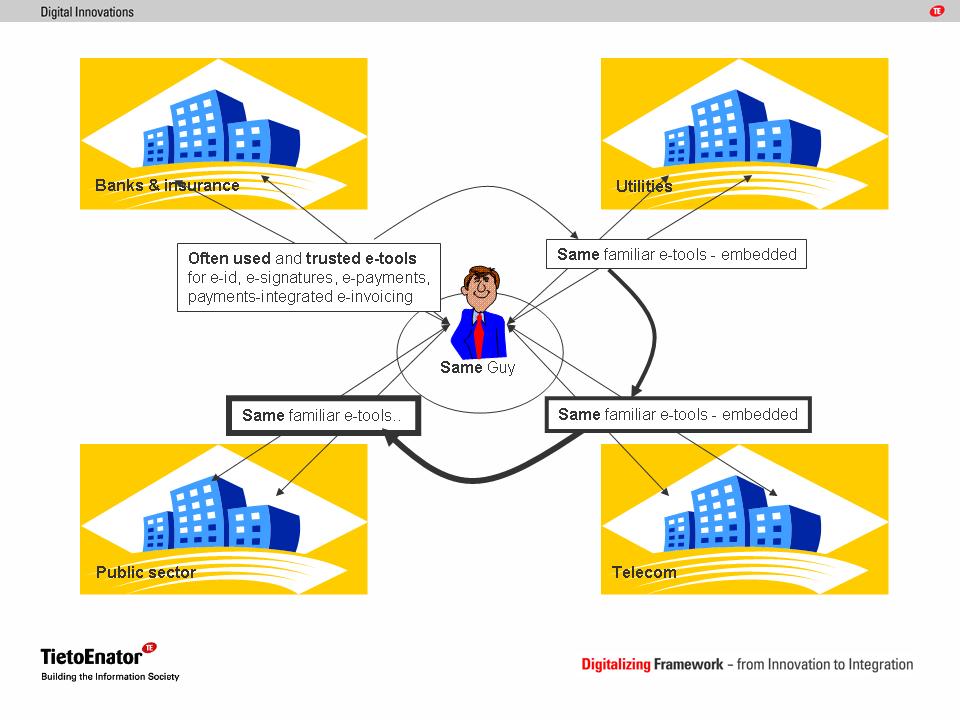
- We seem to continue to move into more vertical solutions and deeper vertical solutions, when it is clear that better value for customers are delivered by horizontal solutions – those that work in the same way with all partners in all directions. There is of course space for further procurement-driven value chain building – but it should happen increasingly with generic tools.
- We talk about end-user centricity – but we do not intensively enough focus on the driving wheels when it comes to the only critically important element in innovations – the critical mass of potential users taking their step (if that does not happen – all money and time spent has been lost – at least for the moment. But it is not the money lost that hurts most – it is the "ice-age" that usually follows – no further investments, no fine-tuning, no learning from mistake as those involved move elsewhere (opportunity to make same mistakes again – instead of learning from them). Which are then the wheels that have the traction needed?
Wheel 1: Clinical simplicity in design, functionality and communication of user interface and tools.
Wheel 2: Reuse tools that citizens already have – are using frequently and trust – create economy of repetition, economy of scope and economy of re-use.
Wheel 3: Understanding the everyday practices of end-users – what all is needed to make a service complete and completed in real time.
Wheel 4: Omnipresent devices create the critical mass faster – promote mobile phones (today really multimedia computers) for all information and interaction
Please feel free to add wheels…




 Posts
Posts


