Showing posts with label banking. Show all posts

Monday, February 16, 2009

Banks - how about focusing on new value?

Banks - especially Investment banks - are now being squeezed from all sides - revaluation of securitized papers to unrealistically low market price levels, losses from credit books as economies nosedive, new costs from all sorts of more or less needed regulation, restructuring costs etc - all also leading to higher funding costs.

On the other hand there is clear evidence that customers are prepared to pay for reliable house banking relationship (only to forget it again when times get better..) - in good times you can manage with bad bankers but in bad times you cannot manage without good ones (I have been through a couple of downturns in 30 years as a commercial banker - and dare to say that we managed to keep virtually all enterprises afloat that were worth the effort). The normal behavior also then was that higher risks called for higher margins, more securities and stricter covenants and as long as the owners chipped in their part,  financing was reorganized and even increased to bridge over the troubled waters.

Despite most bankers having done a proper job then and now - media at large was and is again resorting to lynching mentality - "a banker cannot be good - hang them all..". With nobody questioning this, it is to expected that elections will be won with this kind of slogans (even if media credibility is systematically being eroded - by media itself). Then it has to be said, that the case of stupid extravaganzas in a few instances - after having had to resort ot taxpayers' support - makes it easy for the populists.

But what should banks do now to start to rebuild their scattered images? Back to profitability and basics is for sure one route - simple robust real services - less marketeer driven gimmicks and "products" nobody really understand. But more than that, there is a big area where banks are now needed more than ever before. This is the what we call extended payments services. All the way from potentially doubling the payment volumes by moving into networked sourcing, routing and presenting e-invoices, e-orders, e-confirmations, e-salaries, e-pensions etc to e-id, e-signatures and real time payments - services needed in the networked and increasingly real-time economy. Only banks have the possibility to handle this in a cost-efficient way for the largest sector - the SMEs and the consumers. As the investment needs are minimal and the sales force is there anyway it should not be difficult to reach profitability as soon as the transaction volume tipping point is achieved. The downside is in any case minimal.

Lowering of costs > better productivity > stronger competitive position in a global economy is now badly needed in the entire corporate customer base. Will banks take their responsibility? 

Saturday, September 29, 2007

Banks just have to

Technorati Tags:

start offering e-invoicing as a part of payments. A few simple reasons:

1. it is a huge value for enterprises - highest savings estimate in EU 243bn€ per year (EACT) - only in b2b and only in processing efficiency - many more similar categories waiting

2. only banks have the ready infrastructure (payment systems, e-banks, security)

3. only banks have the necessary wide sales force and economy of scope as this adds an extension to existing payment and cash management products

4. only banks can use this to make "ipod"-like invoice financing and foreign exchange risk cover available

5. all invoices should lead to payment - automation of this and later account reconciliation are central elements in the total savings

6. banks' legislated role as defense against money laundering is needed here as well - less fraud risk in invoicing saves considerably - both time and money

7. ECB and EU more or less want to force banks into this - also to make SEPA a business case for them

8. this is true customer value - earning money from "good-for-society-at-large" is quite different from earning money from junk-mortgages and junk-bonds

9. and it only one step - but the broadest possible - that enables the next step - for the corporate mass market to use the same tool for e-orders and e-confirmations

10. the staircase leads to the Real Time Economy - real time transfer of invoice information, real time payments and real time accounting and less store&forward based costly IT-processing in the background.

SIBOS in Boston - next week is good place for this discussion - anybody still in doubt - and if not - how to get there fast.
I will be there.

Thursday, September 27, 2007

EBRF 2007

Useful and interesting material. My own presentation focused on the practical steps to get to a real time economy (real time invoicing, real time payments, real time accounting etc) - will be added later.

Saturday, July 28, 2007

How about creating some new value?

Competition is fierce in banking and it seems to continue to lead to crisis situations. Now it is the excessive granting of subprime mortgages and the onselling of these to investors. In the past we have read about consumer loans repeatedly getting sold on too thin margins and too high risk, too muçh credit being granted to badly managed countries and companies, too high trading risks etc.

Should banking try to break out of this seemingly vicious circle? In stead of quarterly capitalism driven focus on driving volumes and income up with too little regard to risk and reward and costs down in a way that also hits necessary investments in new valuable services and industrywide standardization - would it be time to innovate the way to the blue oceans?

In today's world there certainly are a multitude of new needs to cater for.
Nordic focus - appeared in Financial i June 2007 issue

My name is Guy. Same Guy and I make digitalisation happen. Where does my name come from? From the fact that there is an urgent need to remind all sorts of service providers that they serve the same customer for his many needs and in different roles and that there are important opportunities to speed up digitalization if this is realized.

Why is this urgent? Because digitalization is so important for corporate and public sector productivity, because digital services are so central to corporate competitiveness in an open global economy and because the context end-users are living in is continuing to become overcrowded with information, alternatives and activities. As there is less time for any one thing it is imperative to, by all available means, lower the threshold for taking new services into use. We have seen good examples of how this can be done by making things clinically simple – but that is not enough any more. Further digitalization of services should be mandatory – and at least when tax payers money is involved – build on what the end user already is used to and trusts. This is where banks have a big role to play – and a big responsibility.

What can banks do to speed up digitalization in society at large? Naturally, they should offer all their own services in a digital format, thus feeding the massive ‘e-habit’ only large volume financial transactions can create. Secondly, they should develop new streams of income from valuable services and cut their costs (banks in Finland have halved their total costs with the help of digital services). Then these tools need to be embedded in e-business and e-public sector services. One such example is the use of e-banking log-in tools for identification of people in public sector services and for e-signatures on documents between third parties. The alternative – to have to equip people with a separate public sector smart card and readers could easily cost EUR 40 upfront (there are 460 million citizens in the EU). Experience also shows that public sector smart cards are seldom used, as most people prefer to use already familiar, in this case bank tools.

From a corporate productivity and competitive service viewpoint, more significant development is taking place in the area of e-invoicing. E-invoicing is of course nothing new – it has been around for decades – mostly in vertical environments using proprietary, expensive and inflexible technology – resulting in further costs when trying to make disparate formats interoperable via re-formatting. This has lead to a situation where the SME sector (17 million enterprises in the EU representing the highest potential for digitalization) have not had the tools to join digital value chains or have been forced to use different applications or portals with different suppliers and customers.

The solution to this dilemma has been found – it is to make invoice transportation use the payment network, payment file technology and netbanks for inputting and outputting – just like sending and receiving payments – using the payment address for a corporate or private e-invoice receiver. When launched by banks in Finland in 2004 it was a surprise to everyone that so many enterprises signed up right away. The European Commission and the European Central Bank have taken an active role in encouraging banks to create a common standard and launch this concept as a part of SEPA. Estimates from the corporate sector indicate that annual processing cost savings could be in the region of EUR 200 billion. Banks are now moving and this will also improve volumes for traditional e-invoicing service providers. But as the savings are divided into so many small parts, big hands are needed to steer the mass market. Eventually this will be connecting every bank account globally also for e-invoicing and other documents like e-orders.

Again it has been vital to start from the end-user and realize that there are no corporate customers – only human customers – Mr Same Guy in different roles. When it is possible to offer the same tool to the end-user for their needs in private, citizen and employee roles – for the same purpose in different environments or new purposes - significant cost savings can be made, and above all the time to market is shorter.

Bo Harald is head of Executive Advisors, TietoEnator, Helsinki
http://boharald.blogspot.com

Sunday, October 08, 2006

Two paths - interacting and leading to real time completion.

The self service path is very efficiently pulling straight through completion upwards. Only in some cases is there a need form manual intervention. Still this should of course be accepted in the interim as end users expect it to be possible to complete transactions on the net.

As said before - the most important way to progress on the self service/web usage path is to let the enduser use already familiar and trusted tools from e-banking - such as e-id, e-signatures, real time e-payments and e-invoicing which works as payments. Other aspects naturally include clinically simple functionality, strong selling and benchmarking. Too often the importance of transparent pricing is forgotten - ie if manual or paperbased services are not priced at cost + value for customers it will take very long for them to move to more cost efficient services (which naturally also should be priced at cost + value).

Some seriously misguided consumer protectionists have zoomed in on banking and tried to stop visible pricing of services. This is a manifold way of serving consumers very badly. Firstly: there are no free services - only openly priced or with charges hidden in other services. Secondly: how can we expect banks to compete if they are not allowed to show their prices. Thirdly: how can we expect banks to invest in new progressive services if they are not allowed to charge for them. Forthly: is it really just that some people are using costly manual services without paying the costs - instead burdening unsuspecting fellow customers.

It has puzzled me for some time that there are not more demands for transparent pricing - which guides the consumer to make logical choices - knowing what it actually costs him. When we introduced a 10 cent for for check forms back in 1983 in Union Bank of Finland it lead to an immidiate move to card payments (resulting in lowest use of cash in the world). So transparent pricing both eliminated check usage and cut cash usage dramatically - billions of savings even in a small country - and all of this has found its way to the consumers pocket - mostly through price competion but also as bank dividends that mostly go to pension funds anyway.

The machine to machine path will become very interesting with the help of rfid but also introduction of ordering and statements in addition to e-invoicing in netbanks will further m2m interaction.

Sunday, September 10, 2006

Asia-Europe Business Forum - real time reflections.

Sitting at the 10th Asia-Europe Business Forum in Helsinki listening to opening adresses by the president of Finland, Jorma Ollila (chairman of Nokia and Shell) and Mr Fu Chengyu (CEO of CNOOC). Main point - much shared by the audience is that protectionism is not an answer to social responsibility - rather a well proven recipy for disaster. When will politicians in Europe start to behave like statesmen on a wider scale? Today it is more an exception than a rule - and the press is far too often driving shortsighted populist views and too seldom coming with searching questions.

As trade growth is of mutual interest it is of course essential that it is made easier - this will happen by as a first step integrating private and corporate mass market invoicing with payment systems and e-banking. As 93% of all enterprises are micro and 6% small (less than 50 employees) it is obvious that only solutions which can be implemented without investements and software installations will make fast process - this is where corporate e-banking services can make it happen.

My own presentation is entitled: Two Parallel Paths towards a Global Real Time Economy - will enclose it later.

Thursday, August 24, 2006

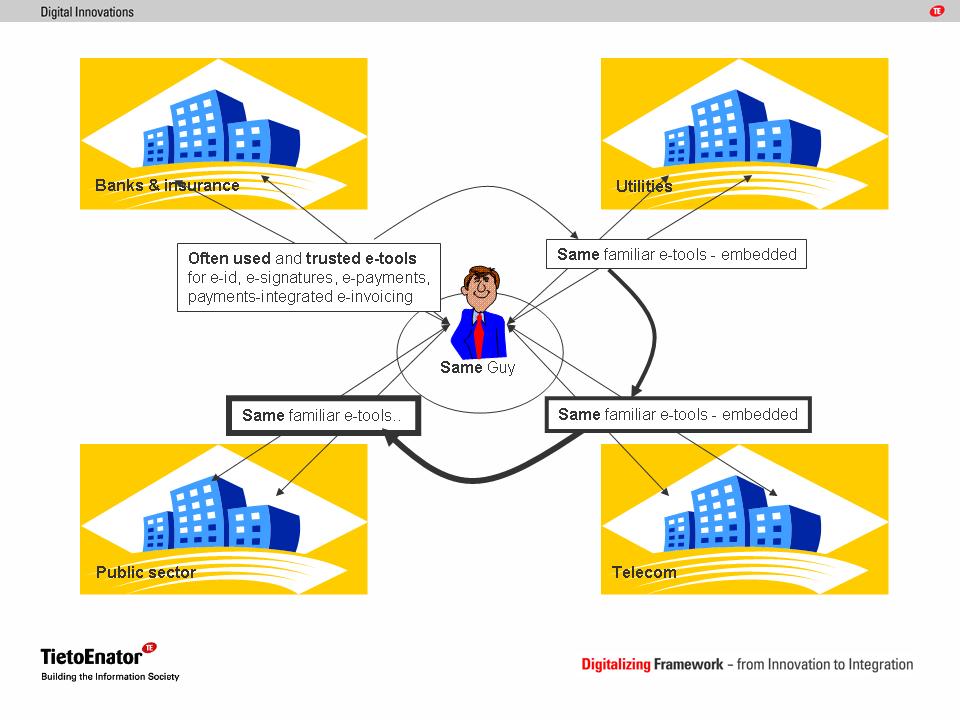
2. It is Mr Same Guy - understand how the enduser´s practise can be served in a way that makes him move faster.

This is the main point - the customer must be treated as one person - he has already learned to use and trust e-banking tools - and when other serve him they will get a much faster take-up if they let him use familiar tools - embed banking in there own service (and of course also the other way). E-banking is an ideal supplier of the tools as they are used so often, already invested in, have to be very secure and are also a part of the defence against money laundering.

Other aspects include every possible effort to simplify the service and improve discoverability with various methods.

This picture is also pointing out that customers frequently are dealing with banks, utilities, public sector, teleoperators etc in different roles - as private and corporate customers. Of course they should have a similar user experience in all cases. Economy of repetition cross sectors.

Friday, August 11, 2006

work1. Remember to network - examples from e-banking

Starting to go deeper into the list below, I recall the earliest networking experience from e-banking - dating back to 1984 (private e-banking was launched in 1982 - corporate in 1979 in Union Bank of Finland - now Nordea Bank). In those days PCs were not that widely in use at home and modems even less common. So the bank agreed with employers that it is in everybody's interest (time saved) when employees who use PCs at work (usually linked to external telenetworks) could use them also for their private e-banking. This networking led to a very much faster uptake and customer value than would otherwise have been possible and created an early e-habit and e-trust platform that now is the base for a worldleading position for example in the public sector (reuse of e-banking tools).

The next networking example from the e-banking history came 1992 when customers could log in to the bank and continue to all major insurance companies - big savings for them as they did not need to build own strong identification. This meant that banking became embedded in insurance services and vice versa.

This reuse of bank e-id (also for signing third party contracts as is the case with loan agreements in the banks' services) took a big step forward when the Finnish Ministry of Finance in 2002 recommended the use or bank-id for the public sector as an equally strong method as the state issued PKI smart card (which has failed to gain usage). Estonia in 2005 is an even more striking example of what citizens prefer: 363 000 Estonians used e-banking id (800 000 have them) when filing tax return - 904 used the state issued smart card (1 000 000 distributed). This use of bank-id has probably taken Estonia's tax service and public sector at large to a global lead position.

Accenture's High Performance in Government report (p35 figure7) shows the results of the co-operation with the banking sector - Finnish citizens are very clear global leaders in eGovernment use and eGovernment enthusiasm. Of course it is easy to understand - what could be more conveniant than reuse of bank-id which is so often used and familiar (one-time codes since 1982)? True economy of repetition for the citizen, economy of reuse for the government (massive investment if all citizens would have to be equipped with smart cards and card readers - and a waste as single sector tools will not be used - and ties to one PC, does not work on mobiles etc) and economy of scope and scale for all. Accenture did not quite pick this up but cited some for me unknown anonymous press coverage that would have questioned the role of banks - ie questioning networking..

I could list a good number of similar networking examples from e-banking - payments-integrated e-invoicing is the most recent example - the cost saving potential from e-invoicing for EU has been estimated (by EU) to exceed 100bn€ per year - something REAL for Lisbon.

The leading theme is of course to understand how the citizen's practice of handling all aspects of banking can so very naturally become an essential part of his practice in using for example public sector services. Responsible civil servants are of course taking every opportunity to save tax payers' money - but also to make it possible for them to benefit early from e-services without any need to invest in or learn to use new devices. This service of practices is very much connecting to what Oskar states in his Practice Design blog. "This helps companies to bec0me less fragmented in the operations. Customers are very different, whereas practices can in many cases be universal." In this particular case cross-organisations and both for the citizen's private and employee role in a world-leading private-public partnership.

More examples later.
http://www.meebo.com/rooms