Useful and interesting material. My own presentation focused on the practical steps to get to a real time economy (real time invoicing, real time payments, real time accounting etc) - will be added later.
Showing posts with label real time economy. Show all posts
Showing posts with label real time economy. Show all posts
Thursday, September 27, 2007


Sunday, October 08, 2006
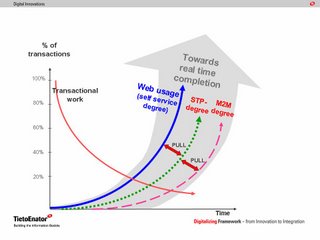
Two paths - interacting and leading to real time completion.
The self service path is very efficiently pulling straight through completion upwards. Only in some cases is there a need form manual intervention. Still this should of course be accepted in the interim as end users expect it to be possible to complete transactions on the net.
As said before - the most important way to progress on the self service/web usage path is to let the enduser use already familiar and trusted tools from e-banking - such as e-id, e-signatures, real time e-payments and e-invoicing which works as payments. Other aspects naturally include clinically simple functionality, strong selling and benchmarking. Too often the importance of transparent pricing is forgotten - ie if manual or paperbased services are not priced at cost + value for customers it will take very long for them to move to more cost efficient services (which naturally also should be priced at cost + value).
Some seriously misguided consumer protectionists have zoomed in on banking and tried to stop visible pricing of services. This is a manifold way of serving consumers very badly. Firstly: there are no free services - only openly priced or with charges hidden in other services. Secondly: how can we expect banks to compete if they are not allowed to show their prices. Thirdly: how can we expect banks to invest in new progressive services if they are not allowed to charge for them. Forthly: is it really just that some people are using costly manual services without paying the costs - instead burdening unsuspecting fellow customers.
It has puzzled me for some time that there are not more demands for transparent pricing - which guides the consumer to make logical choices - knowing what it actually costs him. When we introduced a 10 cent for for check forms back in 1983 in Union Bank of Finland it lead to an immidiate move to card payments (resulting in lowest use of cash in the world). So transparent pricing both eliminated check usage and cut cash usage dramatically - billions of savings even in a small country - and all of this has found its way to the consumers pocket - mostly through price competion but also as bank dividends that mostly go to pension funds anyway.
The machine to machine path will become very interesting with the help of rfid but also introduction of ordering and statements in addition to e-invoicing in netbanks will further m2m interaction.
The self service path is very efficiently pulling straight through completion upwards. Only in some cases is there a need form manual intervention. Still this should of course be accepted in the interim as end users expect it to be possible to complete transactions on the net.
As said before - the most important way to progress on the self service/web usage path is to let the enduser use already familiar and trusted tools from e-banking - such as e-id, e-signatures, real time e-payments and e-invoicing which works as payments. Other aspects naturally include clinically simple functionality, strong selling and benchmarking. Too often the importance of transparent pricing is forgotten - ie if manual or paperbased services are not priced at cost + value for customers it will take very long for them to move to more cost efficient services (which naturally also should be priced at cost + value).
Some seriously misguided consumer protectionists have zoomed in on banking and tried to stop visible pricing of services. This is a manifold way of serving consumers very badly. Firstly: there are no free services - only openly priced or with charges hidden in other services. Secondly: how can we expect banks to compete if they are not allowed to show their prices. Thirdly: how can we expect banks to invest in new progressive services if they are not allowed to charge for them. Forthly: is it really just that some people are using costly manual services without paying the costs - instead burdening unsuspecting fellow customers.
It has puzzled me for some time that there are not more demands for transparent pricing - which guides the consumer to make logical choices - knowing what it actually costs him. When we introduced a 10 cent for for check forms back in 1983 in Union Bank of Finland it lead to an immidiate move to card payments (resulting in lowest use of cash in the world). So transparent pricing both eliminated check usage and cut cash usage dramatically - billions of savings even in a small country - and all of this has found its way to the consumers pocket - mostly through price competion but also as bank dividends that mostly go to pension funds anyway.
The machine to machine path will become very interesting with the help of rfid but also introduction of ordering and statements in addition to e-invoicing in netbanks will further m2m interaction.

Thursday, September 14, 2006
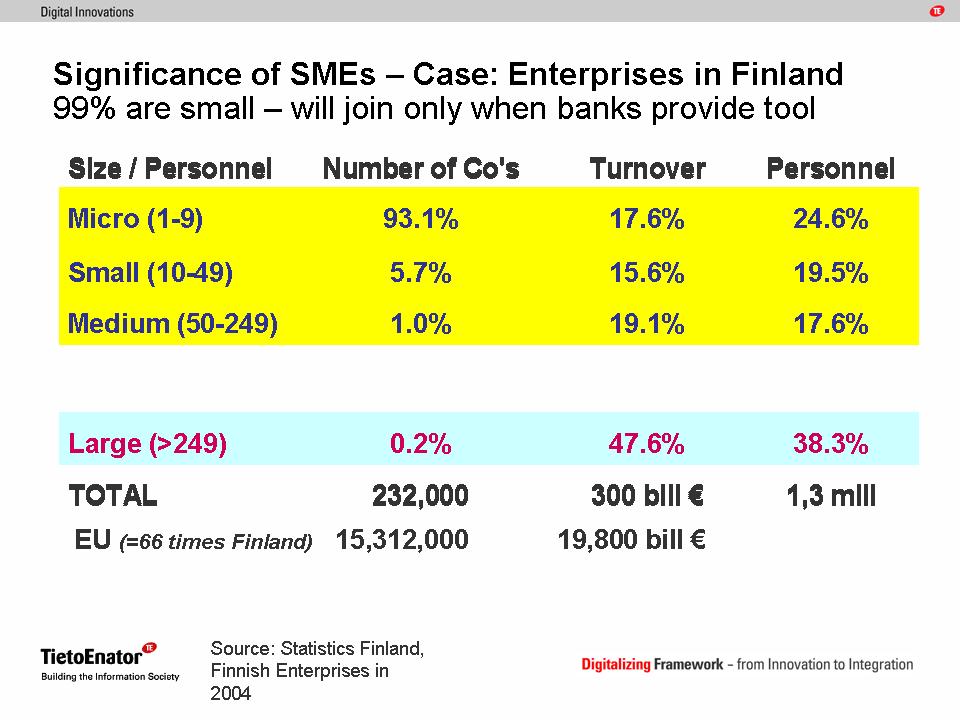
99% of enterprices are small (<50 employees)
And 93% belong to the microsegment and together with small they produce 33% of the turnover and at least the same number of invoices, orders, order confirmations and the like. To get the economy moving towards the real time mode fast these need a tool for sending and receiving these documents that does not call for investments or applications installation. The answer is a template in the netbank for input and the payment network for transport. This has already been rolled out in Finland - it is a proven fact that it is needed and easy to accomplish.

And 93% belong to the microsegment and together with small they produce 33% of the turnover and at least the same number of invoices, orders, order confirmations and the like. To get the economy moving towards the real time mode fast these need a tool for sending and receiving these documents that does not call for investments or applications installation. The answer is a template in the netbank for input and the payment network for transport. This has already been rolled out in Finland - it is a proven fact that it is needed and easy to accomplish.

Sunday, September 03, 2006
The two paths towards a real time economy
There are two parallel main roads leading to the endgoal - real time economy. The first one has been dealt with here already to some extent - the end user centric and networking approach to digital services - leading to fast real uptake of self services at lowest cost.
The other road is automation - machine to maching initiated transactions. This is best served by finding widely used standards. The Single European Payment Area is a very suitable opportunity to go for standards both in remitting payment order files to banks or when using same tools for remitting invoice material.
What should be done early on is to establish the benchmarking - what service in what company or what country has the highest (i) selfservicedegree - % of all, (ii)machine2machine degree - % of all and finally highest degree of real time completion - % of all.
There are two parallel main roads leading to the endgoal - real time economy. The first one has been dealt with here already to some extent - the end user centric and networking approach to digital services - leading to fast real uptake of self services at lowest cost.
The other road is automation - machine to maching initiated transactions. This is best served by finding widely used standards. The Single European Payment Area is a very suitable opportunity to go for standards both in remitting payment order files to banks or when using same tools for remitting invoice material.
What should be done early on is to establish the benchmarking - what service in what company or what country has the highest (i) selfservicedegree - % of all, (ii)machine2machine degree - % of all and finally highest degree of real time completion - % of all.
Subscribe to:
Posts (Atom)


 Posts
Posts